Nov 4
Guest Opinion: Mattachine Society was started to organize gays
Thomas R. Dunn READ TIME: 5 MIN.
The Nazi persecution of homosexuals lurked in the memories of five American men as they gathered in Harry Hay’s Los Angeles home on November 11, 1950. The meeting’s aim was to discuss a new draft of a prospectus, first written by Hay in 1949, calling for the incorporation of an American homosexual organization. By almost any measure, the dangerous and hard-fought meeting was successful, for the men agreed to meet again and proceed with the new endeavor, which would become the Mattachine Foundation. In doing so, these leaders inaugurated a powerful new phase of the U.S. homosexual rights movement. A key facet of the group members’ decision was their agreement with the principles and ideas outlined in Hay’s prospectus. In at least one telling of the story, the men expressed near unanimity on the document, so much so that they declared each of them could have written it themselves. Among the prospectus’s first principles was a simple yet powerful expression of the new organization’s raison d’être: that if homosexuals did not organize themselves for political action soon, they would likely suffer the same fate as German homosexuals just a few years prior.
Indeed, Hay argued in point A.1 of the prospectus that homosexuals in the 1950s faced an “encroaching American Fascism” that emulated a “previous ... International Fascism” (i.e., Nazism) from the recent past. Like the Nazis, this American Fascism sought “to bend unorganized and unpopular minorities” like homosexuals “into isolated fragments of social and emotional instability.” He supported this claim by noting how, in the Third Reich, “the socially censured Androgynous Community [i.e., the homosexual community] was suborned, blackmailed, cozened, and stampeded into serving as hoodlums, stool pigeons, volunteer informers, concentration camp trusties, torturers, and hangmen, before it, as a minority, was ruthlessly exterminated.” For these and other reasons articulated thereafter, Hay’s prospectus argued that the “Androgynes of the World” must organize. If not, they risked their own destruction on American shores. What Hay’s document only hinted at in text but implicitly screamed was that this fearful end of U.S. homosexuals would come at the hands of the same entity that stamped out their European forebears: a cruel, corrupt, and legally sanctioned anti-homosexual police force.
As discussed in the introduction, Nazi police forces played a significant role in executing the Third Reich’s persecution of homosexuals. This point is often lost in more contemporary public memories of the pink triangles, which emphasize homosexual experiences in Nazi concentration camps to the exclusion of all else. But while camp administration – and the homosexual suffering therein – fell under the powers of the Nazi police state (broadly conceived), far more homosexuals were persecuted outside the camps than inside. In those more common situations, it was the police in the guise of the Gestapo (i.e., the secret police) or the Kripo (i.e., the Kriminalpolizei or criminal police) that facilitated the harassment, humiliation, blackmailing, blacklisting, arrest, beating, interrogation, castration, and detention of homosexuals. Though the Nazi “police” appeared far different from how most Americans understood law enforcement then and now, the Nazi police apparatus was the main tool of homosexual aggravation, persecution, and death described in Hay’s prospectus.
As a member of the Communist Party, Popular Front participant, and passing interlocuter with previous homosexual leaders, Hay was keenly aware of the role Nazi policing played in the destruction of the German homosexual movement. But the prospectus and the U.S. organization it called for were not simply about documenting the past – they were also concerned with looming threats to American homosexuality in the present. As the prospectus indicated, the policing of German homosexuals under the Third Reich resonated strongly with American homosexuals’ fears after 1950. The men who joined Hay to discuss his prospectus expressed similar anxieties about law and policing in the months following Mattachine’s creation. Among them was Rudi Gernreich, a Jew and Austrian refugee who fled the Nazis as a child. Gernreich was so concerned the young organization would be raided and dismembered that he warned, “If we repeat the errors of Hirschfeld’s German Movement ... we could set the potential of an American Gay Movement back for decades to come.” Dale Jennings, another founding member of Mattachine, who famously emerged victorious from his own anti-homosexual policing case in 1952, believed that the group had been infiltrated by the police or FBI within its first year. For these reasons, as movement historian C. Todd White described, “for the first two years of Mattachine, each time members gathered in private homes, they did so fearfully. Shades were always drawn when they couldn’t meet in a basement, and someone always kept a sharp lookout for the police or FBI.” The founders of Mattachine were not the only homosexuals who felt this way. U.S. homosexuals knew well that even if the Nazi regime had been eliminated, the anti-homosexual police apparatus they used to crush German homophiles was alive and well in small towns and big cities across the United States.
But these shared anxieties about anti-homosexual laws and policing in the United States and Nazi Germany could also serve as a powerful rhetorical resource for this nascent American community. If used proactively, such comparisons could help the newfangled group define itself as a persecuted minority (as Hay and others believed it was). Such comparisons also had the potential to rally the homosexual community for future action, particularly by turning its sentiments against the institutions of law and policing that many of them had been taught to revere their entire lives. Strategic historical allusions equating Nazi and U.S. laws and policing thus offered a growing American homosexual community the chance to imagine a world in which homosexuals could live free of police terrorism and its horrible consequences.
To that end, members of the newest iteration of the U.S. homosexual movement began to make these comparisons plainly before their community of peers. This work was made possible via an emerging set of homosexual publications beginning in 1953. Chief among the publications to print these kinds of mnemonic comparisons were “ONE: The Homosexual Magazine” and “Mattachine Review.” The two magazines were quite different and adopted conflicting ideas and approaches to U.S. homosexual politics. But in both passing comments and extended broadsides, the homosexuals who created, read, and responded to both publications made powerful connections between an intensifying, postwar anti-homosexual crackdown by U.S. law enforcement and the crimes of the Nazi police, which had occurred less than a decade earlier. In doing so, they again demonstrated how central remembering the Nazi persecution of homosexuals was to the establishment and enactment of a U.S. homosexual rights movement.
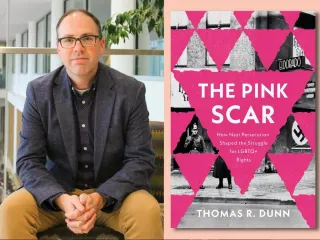
Thomas R. Dunn, a gay man, is the author of “The Pink Scar: How Nazi Persecution Shaped the Struggle for LGBTQ+ Rights,” from which this is excerpted. Published with permission of Penn State University Press.