Nov 18
Politicos, emperors pay tribute to B.A.R. founding publisher
Cynthia Laird READ TIME: 2 MIN.
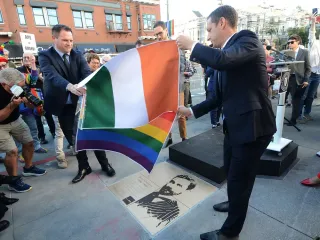
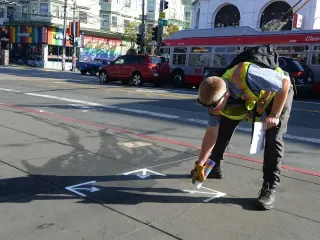
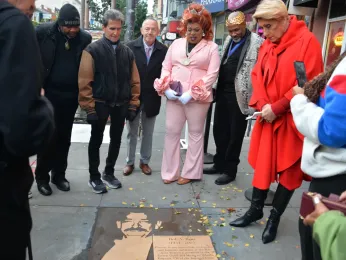
On a crisp fall day, San Francisco politicos, emperors, and members of the Bay Area Reporter family paid tribute to the paper’s founding publisher, Bob Ross. The occasion was the unveiling of a plaque for Ross by the Rainbow Honor Walk outside of 508 Castro Street, near the site of the former Harvey’s bar and restaurant.
Ross, who died in 2003, likely would have approved of the November 17 ceremony, as he was referred to as intimidating, a curmudgeon and even “an asshole,” all accurate descriptors, several speakers agreed. But his contributions to the LGBTQ community were many, and they were also noted.
The Rainbow Honor Walk is a nonprofit that honors deceased LGBTQ luminaries with sidewalk plaques throughout the LGBTQ Castro district. Donna Sachet, a former empress and onetime B.A.R. society columnist, serves as board president for the honor walk. The project began in 2014 with the installation of the first 20 plaques, said Sachet, who now pens a column for the San Francisco Bay Times. Additional plaques were installed in 2018, 2019, and then, 2022. The three-year gap was attributed to changes in city rules, she explained.
It also costs money to design and install the plaques. As previously reported, the honor walk is looking at possibly changing how it selects people and fundraises for the plaques. Right now, there are about 20 people who’ve been selected but plaques for whom have not yet been installed.
Last month, a plaque honoring Irish human rights activist Roger Casement was unveiled on the other side of Castro Street from the site of Ross’ plaque. Plans are underway to install four more plaques currently held in storage by the end of the year or in early 2026, Sachet said, with one being for the late lesbian trailblazer Phyllis Lyon, whose late wife Del Martin is already honored with a plaque on 19th Street.
Gay San Francisco Board of Supervisors President Rafael Mandelman arrived late to the unveiling, having been at a committee hearing.
“I think the Rainbow Honor Walk is doing amazing things,” he told the B.A.R. “Now, Bob Ross is very much getting his due.”
Gay former state legislator and San Francisco supervisor Mark Leno told the small crowd that included B.A.R. staff, freelancers, and other community members that Ross was from a different era.
“Bob was from a generation of queer folks who came to San Francisco about 20 years before I did,” said Leno. “But things were beginning to change and Bob Ross was so much a part of that.”
Ross worked in restaurants, notably the old PS Restaurant as a chef, and, as a gay man, believed that the LGBTQ community had strength in numbers. He knew gay bar owners who were tired of paying off the police to stay in business, so they created the Tavern Guild. It met regularly to discuss issues affecting the community.
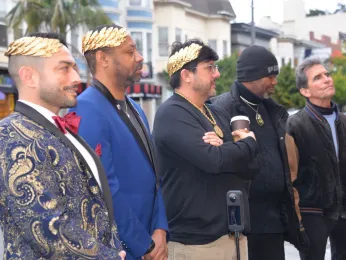
Former emperor
Leno also noted Ross’ involvement with the San Francisco Imperial Court, a drag philanthropic organization started in 1965 by the late José Julio Sarria, a gay Latino veteran who was Empress I and was the first known gay person to seek elected office when he unsuccessfully ran for the Board of Supervisors in 1961. The current reigning Emperor Ashle Blow and reigning Empress Afrika America were on hand, along with former emperors John Carrillo (28), John Weber (36), JP Soto (42), Terrill Grimes (47), and Michael Chua (51). Ross himself was Emperor 7 after Norton, and some believe he paid a price for that.
“It may have cost him a seat on the Board of Supervisors,” Leno said, referring to the fact that Ross was named by gay supervisor Harvey Milk in his “political will” as someone who should succeed him if he was killed. Milk and then-mayor George Moscone were assassinated on November 27, 1978. Then-mayor Dianne Feinstein, however, was reportedly not pleased that Ross was at the time the reigning emperor and disliked the drag connotations that the Imperial Court stood for. (Feinstein died in 2023.) Ultimately, Feinstein named Harry Britt, a gay man, to Milk’s seat. Ross later served on the Golden Gate Bridge Highway and Transportation District board for 18 years.
Leno said that he thought Ross “enjoyed his curmudgeoness.”
Sachet noted that Ross is the first former emperor to be recognized by the honor walk. Sarria’s plaque was included in the first batch.
Blow pointed out that Ross was very active in the old AIDS Emergency Fund and the former New Leaf: Services for Our Community. He served as a board president for Meals on Wheels San Francisco.
Thomas E. Horn, a gay man who runs the Bob Ross Foundation and became publisher of the B.A.R. after Ross’ death, said that Ross was not a newspaper person, but nonetheless saw the need for such a publication.
“Although we were everywhere, we weren’t talking to each other,” Horn noted. “Bob knew there was strength in numbers, and you can’t have that without community.”
Ross, said Horn, “put together a fantastic operation” in starting the B.A.R.
As he thought about his legacy, Horn added, Ross set up the foundation, which has continued to give funds to charitable organizations.
Michael Yamashita, a gay man who is the current owner and publisher of the B.A.R., said that Ross gave him his first job out of college at the paper, and later named him office manager. Ten years after Ross’ death, Horn handed the paper over to Yamashita.
“He was a real asshole sometimes,” Yamashita said of Ross, yet “he had a soft spot and he helped a lot of people.”
“I loved Bob so much,” Yamashita said through tears.
Gay former supervisor Bevan Dufty added some levity to the celebration, though he noted Ross could be intimidating.
“In the spring of 2002, Bob invited me to lunch and he said, ‘I’m not going to endorse you for supervisor,’” recalled Dufty, who was running for the Castro-centered District 8 seat at the time.
Dufty said that what he didn’t realize then was that Ross and gay longtime B.A.R. political columnist Wayne Friday didn’t always share political beliefs. Friday, who died in 2016, used his column to relentlessly promote Dufty’s candidacy, even as the paper endorsed Tom Radulovich, a gay man who at the time served on the BART board.
“Not a week went by that Wayne Friday didn’t have my picture in the paper,” Dufty recalled.
Dufty went on to win the race and served for two terms. He was later elected to the BART board, where he also served for two terms.
“Bob taught me that sometimes you can win by losing,” he said of failing to nab the paper’s endorsement but emerging victorious in the race.
Dufty also mentioned the B.A.R.’s well-known holiday parties that were held in Hayes Valley and how Ross decided which politicians would get a coveted invitation.
“Getting invited to the B.A.R. holiday party was like a Good Housekeeping seal of approval,” said Dufty. “You might not be invited back next year.”